Your plugs & sockets
Voltage
120V
Frequency
60Hz
Plugs
A, B

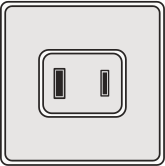
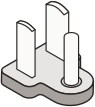
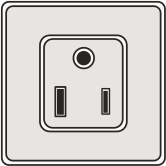
Plugs & sockets in Congo (Congo-Brazzaville)
Voltage
230V
Frequency
50Hz
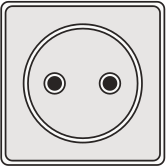
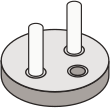
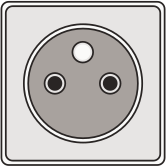
Plugs
C, E
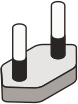
Best Travel Adapter for Congo (Congo-Brazzaville)

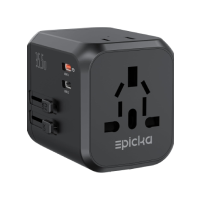
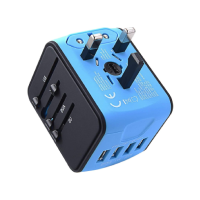
Travel Adapter for Congo (Congo-Brazzaville): Do You Need One? (Venezuela → Congo (Congo-Brazzaville))Adapter Needed
If you're heading to Congo (Congo-Brazzaville) from Venezuela, sorting out the power situation is one of the easiest pre-trip wins. Below you'll find the plug types, voltage, and frequency used in Congo (Congo-Brazzaville), whether you need an adapter, and which devices are safe to plug in.
Do you need a travel adapter for Congo (Congo-Brazzaville)?
Yes, you'll need a travel adapter. Venezuela outlets use Type A/B plugs, while Congo (Congo-Brazzaville) uses Type C/E. Because the two don't overlap, your Venezuela plugs physically won't fit Congo (Congo-Brazzaville)'s sockets without an adapter. Pick one up before you leave, since airport and hotel prices are usually marked up.
What plugs and sockets does Congo (Congo-Brazzaville) use?
Congo (Congo-Brazzaville) uses these power plug types: Type C (Europlug): two round pins, ungrounded, and the most widely used plug across Europe; Type E: two round pins with a hole for the grounding pin in the socket, used in France and Belgium. Outlets run at 230V and 50Hz. Coming from Venezuela (Type A/B), you'll want a Type C/E adapter to match these sockets.
Voltage and frequency in Congo (Congo-Brazzaville)
Congo (Congo-Brazzaville) supplies 230V at 50Hz, which differs notably from the 120V used in Venezuela. This matters most for single-voltage, high-wattage appliances such as hair dryers, straighteners, curling irons, and electric kettles. Plugging a 120V-only device into a 230V outlet can overheat or destroy it. Check each device's label: if it reads "INPUT: 100-240V" it handles both and you only need a plug adapter; if it lists a single voltage, bring a voltage converter or leave it home.
Will your devices work in Congo (Congo-Brazzaville)?
Phones, tablets, laptops, and camera chargers are nearly always dual-voltage (100-240V), so they work in Congo (Congo-Brazzaville) with just a Type C/E plug adapter, and no converter is required. The devices to watch are heat-based appliances: hair dryers, flat irons, and travel kettles are often single-voltage and can fail on Congo (Congo-Brazzaville)'s 230V supply. Many travelers simply buy a dual-voltage travel version or rely on the hotel's hair dryer.
What travel adapter should you buy for Congo (Congo-Brazzaville)?
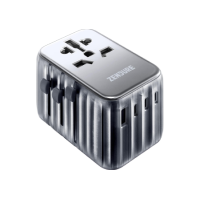
For Congo (Congo-Brazzaville), look for an adapter that converts your Type A/B plug to Type C/E. A universal travel adapter is the most flexible choice, since it covers Congo (Congo-Brazzaville) plus most other destinations and usually adds built-in USB and USB-C ports so you can charge several devices from one socket. If you only ever visit Congo (Congo-Brazzaville), a dedicated Type C/E adapter is smaller and cheaper.
Tips for charging your devices in Congo (Congo-Brazzaville)
Pack at least one adapter per traveler, and consider a small power strip from home, which turns a single Congo (Congo-Brazzaville) outlet into several. Ordering online before you fly is almost always cheaper than airport kiosks.


